The Boy Who Held the Door (and those that held him)
I wass having brunch with my younger sister recently and she brought up something I had completely forgotten.
A poem.
The Boy Who Held the Door.
I dug it up and expected to feel embarrassed, but instead, I felt recognised. Not because the poem was particularly good. Because I realised I had been writing about the same thing for far longer than I knew.
When people hear a title like The Boy Who Held the Door, they tend to imagine a hero standing between his family and danger. A child sacrificing himself so others can remain untouched.
That is not what happened. My siblings were never unaware. They lived in the same house. They heard the same voices. They felt the same tension. They saw the same storms.
We all knew. We simply responded differently.
Looking back, I think that is what the poem was really trying to say, even if I lacked the words to say it properly at the time. The door was never about protection in the absolute sense. I could not save anyone. I certainly could not save everyone. I could not stop difficult things from happening. I could not remove pain. I could not prevent disappointment, anger, fear, or grief from reaching the people I loved.
What I could do was try.
Children often discover this long before they understand it. A child hears an argument and turns the television up for a younger sibling. A child learns how to make people laugh. A child becomes helpful. A child becomes quiet. A child becomes responsible. A child becomes successful. A child becomes invisible.
All of them are attempts to hold a door.
Not to stop the storm. Just to lessen its impact.
When I think about my own childhood, I can see those attempts everywhere. I can see my younger self trying to absorb what he could. Trying to make things easier. Trying to stand where the wind felt strongest. Not because I believed I could fix everything. Because I hoped I might fix something.
What I understand now, and what I probably did not understand then, is that I was not the only one doing it.
My older sister was holding doors too. Not my doors. Her own. Perhaps that is why I still admire her. We often talk about resilience as though it looks the same in everyone. It doesn't. One person becomes the peacemaker, another becomes the protector. One becomes the achiever, another becomes the caretaker.
Different doors.Same instinct.
Each of us finding our own way to survive while helping those around us survive too. That is one of the things I find most interesting about memory. As children, we assume we understand the roles people play. As adults, we begin to see the weight they were carrying. The older I get, the more compassion I feel for the people around me during those years. My siblings included.
We were all trying. Some attempts worked. Some did not. Most were made by children who were doing the best they could with what they understood at the time.
Reading this old poem now, what strikes me is not the image of a boy standing in a doorway. It is the tenderness hidden beneath it. The belief that love sometimes looks like taking a hit you hope somebody else won't have to take. The belief that if you can carry a little more, perhaps someone you care about can carry a little less.
I still recognise that instinct. In many ways, When the Room Empties explores the same territory. The language is different. The perspective is older, but he question remains remarkably similar.
What happens when being dependable becomes part of who you are? What happens when carrying becomes your default response? And what happens when you finally realise that the people around you were carrying things too?
Perhaps growing older is not discovering that we were strong. Perhaps it is discovering that we were never carrying it alone.
And so, for no reason other than that it found its way back to me, I thought I would share the poem.
Not because it is perfect.
But because sometimes old words remind us not only who we were, but who was standing beside us.
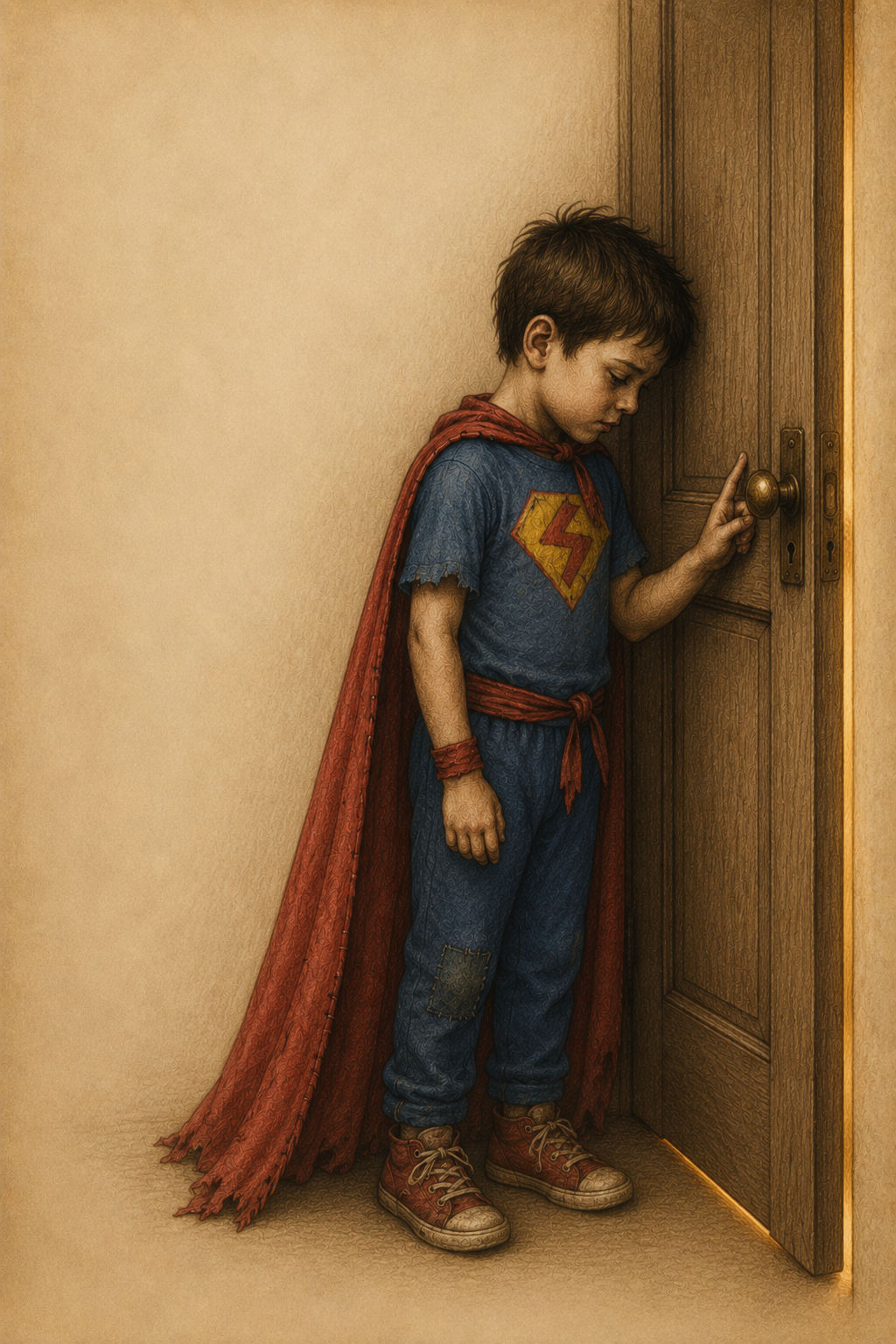
The Boy Who Held the Door
He was not born of thunder,
nor wrapped in banners bright.
The dark would come with broken teeth,
with hands that clawed the night.
He held the door.
No lock.
No shield.
Just flesh and skin and bone.
He never heard the way it cracked,
the cost of standing lone.
A thousand times he met the blow
before it reached their side,
and wore the scars in silence,
with nowhere left to hide.
He taught them how to open doors,
to trust, to laugh, to speak,
and carried every echo still
with courage worn, not weak.
No crown.
No tale of glory sung.
Just one who bore the storm,
and kept his children warm.