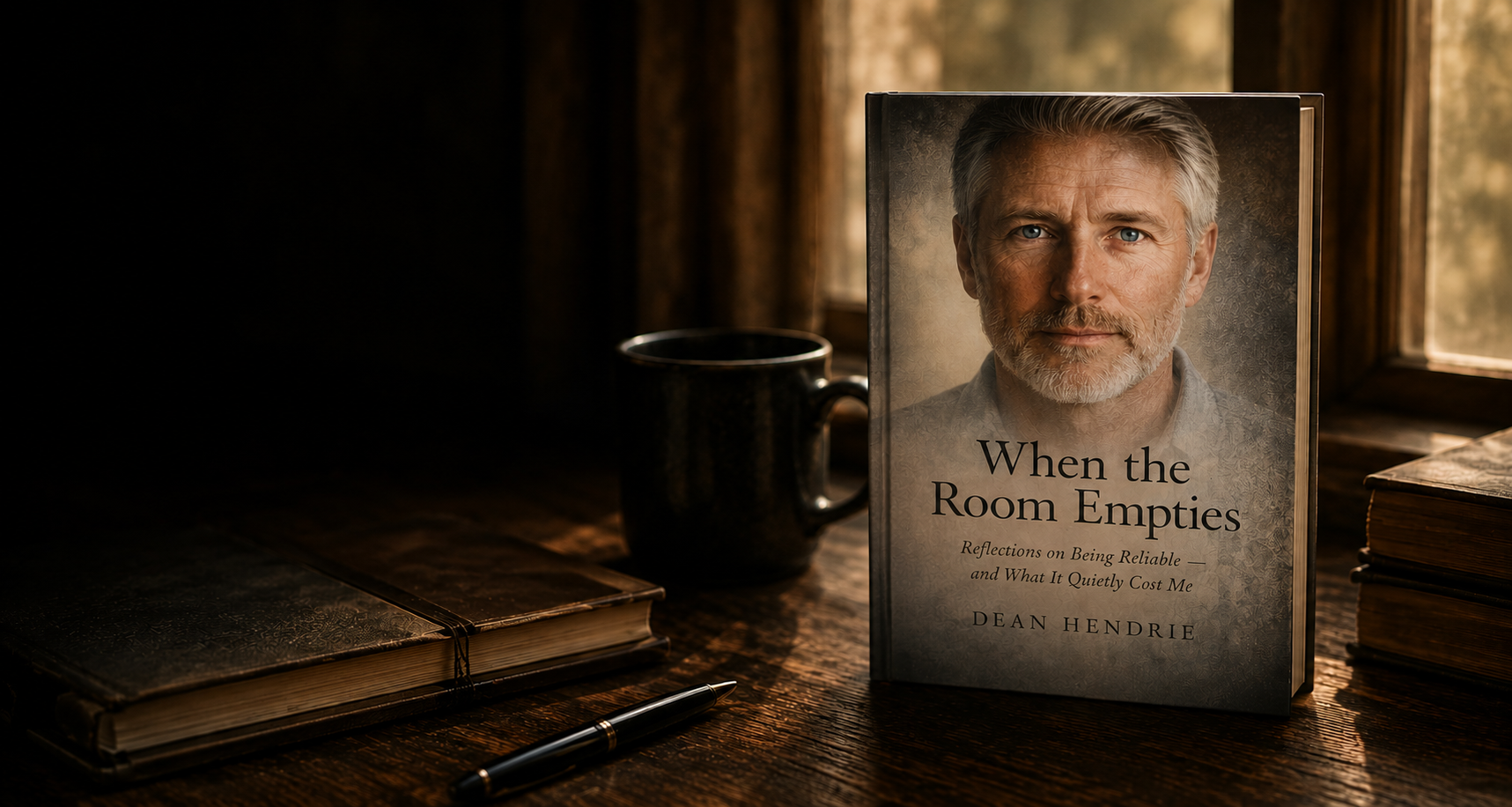
The Book I Never Set Out to Write
When I first stepped away from my saga project (which as I write this sits as a first draft requiring a heavy editing run), it wasn’t because I had finished with it.
Quite the opposite.
The story had become enormous. Mythic. Heavy with questions about memory, endurance, choice, belief, and what it means to keep standing when certainty disappears. I loved it deeply, but somewhere along the way I realised I needed air.
So I stepped back for a while.
_______________________________
“What started as personal reflection slowly became recognition.”
_______________________________
What I didn’t expect was that the quiet reflections I began writing during that break would eventually become a completely different book.
When the Room Empties was never planned.
There was no outline pinned to a wall. No publishing strategy. No grand ambition to become “an author” of reflective nonfiction. In many ways, the book began as private observations. Thoughts about reliability. About carrying rooms quietly. About becoming the person others lean on so consistently that eventually nobody asks whether you’re tired.
The strange thing was how honest those reflections became after I stopped trying to sound like a writer.
I wasn’t trying to teach or to inspire. I was simply trying to articulate things I had quietly felt for years. And in doing so, I started seeing myself with an honesty I hadn’t really allowed before.
Somewhere during that process came a second realisation:
If these thoughts felt this familiar to me, they would probably feel familiar to other people too. Not everyone, of course, but the people who quietly hold things together.
The people who become dependable by default.
The people who answer “I’m fine” instinctively because they’ve become too practiced at carrying weight gracefully.
The people who leave the room last.
That was the moment the seed was planted. Not just for the book, but for everything that followed. Because once When the Room Empties existed, another thought emerged alongside it:
What if people could feel seen earlier?
That question eventually became The School of Magnificent Misfits.
I began thinking about pre-adolescence. About the strange little things children notice about themselves that quietly become sources of embarrassment or isolation. The quirks they try to hide. The parts of themselves they assume make them “wrong.”
And I wondered what might happen if stories instead taught them:
Maybe those things are not flaws. Maybe they are simply part of who you are. Maybe being different does not make you broken. Maybe magnificence often hides inside the things we spend years trying to normalise away.
That idea became its own world.
And somewhere along the line, I realised none of these projects were actually separate from each other.
The saga. When the Room Empties. *Magnificent Misfits. *Even the journals you’re reading here. They all came from the same place.
A desire for people to feel seen.
Not fixed. Not corrected. Not optimised.
Seen.
That realisation eventually led to The Still Press.
Not simply as a publishing house, but as a home for stories of quiet weight. Stories about endurance, memory, wonder, and the people who continue carrying something meaningful long after the noise fades.
I never truly set out to build any of this.
But looking back now, I’m not sure I was ever writing about anything else.