Children Are Relentless Learners
I've found myself thinking lately about just how much of who we become was ever really a choice.
It's an odd thing to wonder when you've reached an age where your personality feels settled. People describe you with such certainty. They tell you that you're dependable, or calm, or driven, or stubborn, or generous, or difficult, as though those qualities had always been there waiting patiently to be discovered. Somewhere along the way, we all seem to accept the idea that personality is something we uncover rather than something we build.
I'm not so sure anymore.
Not because I think we invent ourselves entirely. I suspect each of us arrives carrying certain tendencies, certain temperaments, certain ways of seeing the world. Some children seem naturally quieter than others. Some seem endlessly curious. Some appear to talk before they can giggle. There is undoubtedly something wonderfully unique about each of us from the very beginning.
But I also wonder how much of what we eventually call our personality is simply the accumulation of thousands of tiny lessons that nobody ever realised they were teaching us.
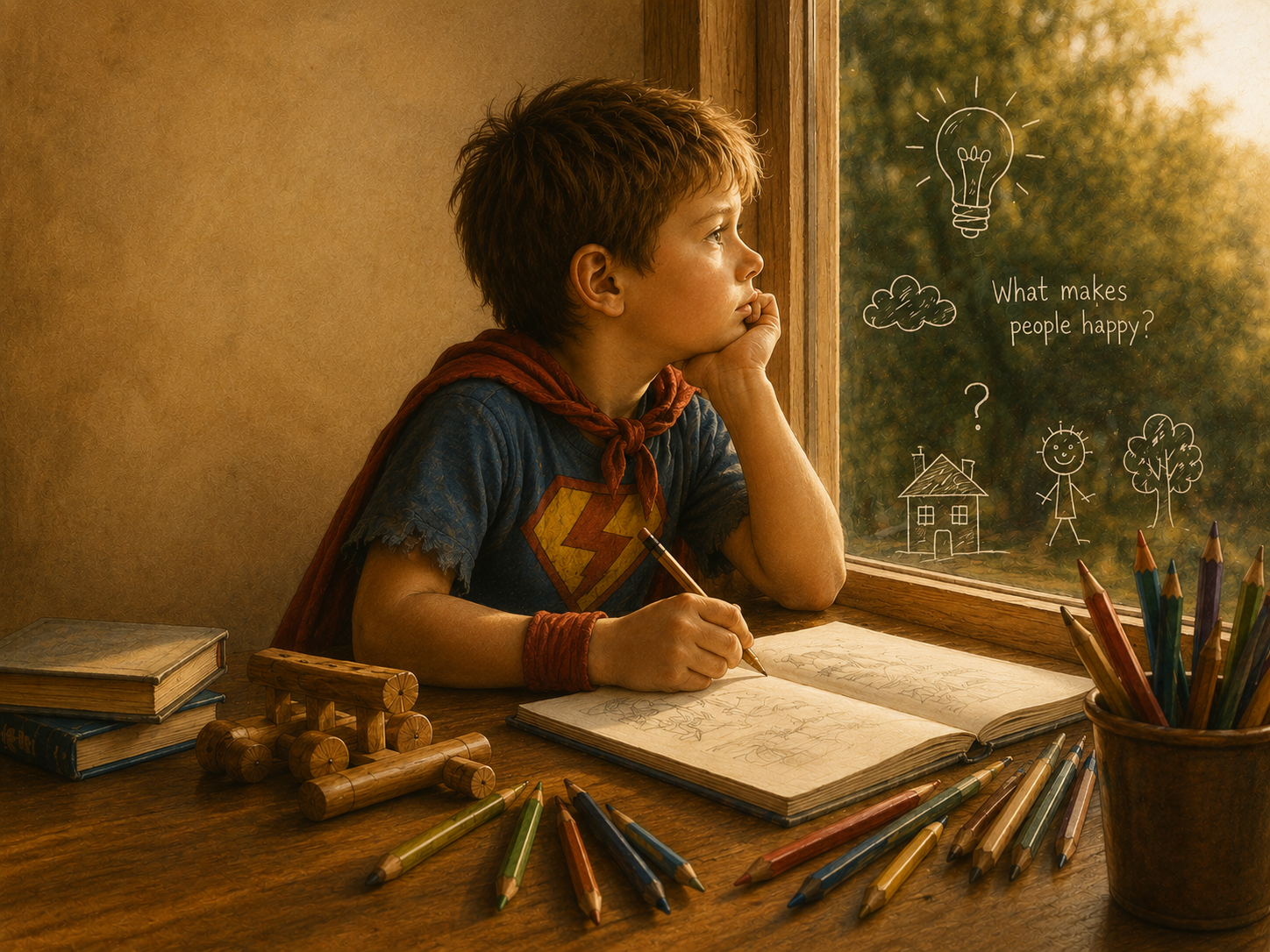
Children, after all, are relentless learners.
That thought has been sitting with me for weeks now, quietly finding its way into conversations I wasn't expecting to have and questions I didn't realise I was asking. Not because children have some extraordinary love of school. Most of them don't. Nor because they spend their days sitting patiently while adults explain the world to them. Anyone who has spent more than a few minutes around a child knows that isn't how learning works.
Children learn because they cannot help themselves.
They arrive in a world that makes very little sense and immediately begin trying to make sense of it. Every room they walk into becomes another opportunity to gather information. Every conversation offers another clue. Every expression, every hesitation, every laugh, every slammed door, every celebration, every disappointment becomes another tiny piece of a puzzle they don't yet know they are assembling. They are not simply listening to what we say. They are studying what we do, comparing today's version of us with yesterday's, noticing patterns that most adults have long since stopped seeing.
I sometimes wonder if children spend less time being taught than they do teaching themselves. They watch. They test. They observe. They try something and wait to see what happens. Then they try something else. They don't call it adaptation because they don't yet have that word. They simply call it being.
Perhaps that's why I find childhood so fascinating. We often remember it through the events that happened to or around us, but I suspect the more important story lies in the thousands of tiny conclusions we quietly drew along the way. Conclusions about people. About safety. About belonging. About conflict. About love. About ourselves.
Most of those conclusions were probably wrong. Not completely wrong. Just the sort of conclusions a child might reasonably arrive at while trying to explain an adult world with a child's experience.
Some were true only in one particular house, or one particular classroom, or one particular friendship, yet somehow found their way into becoming rules about life itself. Children don't simply collect experiences. They quietly begin building theories about the world. About what love looks like. Whether people can be trusted. How belonging is earned. Whether strength is gentleness or force. Who they need to become if they hope to find their place within it.
Those quiet understandings don't remain ideas for very long. They begin shaping behaviour. Behaviour repeated often enough becomes habit, and habit, over time, quietly becomes part of what we eventually call personality. Before we know it, we find ourselves thirty years later describing as personality what may have begun as a child's best explanation of the world.
I don't think children are nearly as naïve as we sometimes imagine. If anything, I think they are astonishingly sophisticated observers, quietly studying a world they don't yet understand, trying to work out not only how it functions, but where they might fit within it. Long before they understand why adults behave the way they do, they become remarkably good at recognising that they do. They know which rooms feel light and which ones feel heavy. They know the difference between someone being physically present and emotionally present. They know when laughter is genuine and when it is trying to hide something. They know when today feels different from yesterday, even if nothing obvious has changed.
What they don't yet possess is context.
They have all of this information flowing towards them, yet almost none of the life experience required to interpret it. They notice the atmosphere before they understand emotion. They recognise tension before they understand conflict. They sense distance before they understand disappointment. They are collecting evidence long before they have developed a framework for explaining it, which may be one of the most remarkable things about childhood.
So they do what every extraordinary learner does.
They begin experimenting.
Not consciously. Not with the careful curiosity of a scientist standing over a laboratory bench, but with the instinctive curiosity of a child trying to answer questions they cannot yet put into words.
What happens if I make everyone laugh?
What happens if I stay quiet?
What happens if I'm good?
What happens if I become useful?
What happens if I stand my ground?
What happens if I apologise?
What happens if I refuse?
The remarkable thing is that they are rarely searching for the perfect answer. They are simply searching for an answer that works. Then, having found one, they use it again. And again. And again, until what began as an experiment slowly becomes a habit, the habit quietly becomes a preference, and the preference eventually becomes something we call personality.
Perhaps that is why understanding ourselves can feel so difficult. We spend years believing we are uncovering who we have always been, without ever considering that we might simply be becoming exceptionally practised at the adaptations that once served us well.
By the time we reach adulthood, those early experiments have become so familiar that we stop recognising them as experiments at all. The dependable person simply believes they are dependable. The funny person assumes they've always had a good sense of humour. The fiercely independent person tells themselves they have simply never enjoyed relying on other people, while the one who avoids conflict concludes they were born gentle, and the one who meets conflict head-on assumes they have always been that way.
Perhaps some of those things are true.
Perhaps some parts of us really are woven into us from the beginning.
But I can't help wondering how many of the qualities we confidently describe as personality began life as answers. Not perfect answers. Not even healthy ones in every circumstance. Just answers that worked well enough for a child to reach for them again the next time the same question appeared.
That possibility has become increasingly difficult for me to ignore, not because I recognise it only in myself, but because once you begin looking through that lens, it quietly starts appearing everywhere.
You notice the colleague who plans for every possible outcome and wonder whether you're looking at organisation or an old agreement with uncertainty. Somewhere, perhaps years before you ever met them, unpredictability may simply have become too expensive, so they learned to prepare for everything they could.
You notice the friend who seems able to dissolve tension with humour and begin to wonder whether you are witnessing a gift they were born with or one they patiently developed because, at some point, laughter changed the atmosphere in a room they desperately wanted to soften.
You notice the person who never asks for help, not because they appear proud, but because self-reliance may once have been the safest conclusion available to them. Dependence wasn't necessarily rejected. It may simply have stopped making sense.
And then, if you're willing to be just a little braver, you begin asking the same questions of yourself.
Not, Why am I like this?
But, What did I learn that made this response feel so necessary?
They sound like similar questions, but they're not.
One searches for blame, while the other searches for understanding.
I have come to believe that understanding is almost always the kinder place to begin. Not because it excuses everything we have done or everything that has happened to us, but because it allows us to meet ourselves with the same curiosity we might offer a child who was simply trying to work out how the world functioned with the information they had at the time.
When I look back now, I don't see a young boy consciously constructing a personality.
I see a relentless learner.
A child gathering evidence without knowing he was gathering it. A child slowly building theories about how people worked, how belonging worked, how strength worked, how conflict worked, and how he might best find his place within all of it. Like every child, he was trying to make tomorrow a little more predictable than yesterday, never realising that some of the answers he found would eventually become so deeply woven into him that he would mistake them for who he had always been.
Perhaps that is the real trick personality plays on us.
It convinces us that our first successful adaptation was our authentic self.
Maybe it wasn't. Maybe it was simply the first tool that worked well enough for us to keep reaching for it.
And maybe that is where adulthood quietly begins.
Not when we stop learning.
Children, after all, never do.
Perhaps it begins when we finally become curious about what we learned... and start deciding which lessons still deserve a place in our lives.